Jip
Berkers.
Professional Development Line · ORM Year 3 · Avans Hogeschool · 2026
I am social, ambitious, direct and I like to take initiative. I often take a bit of a leading role, but I do not need to be the only leader.
The main thing I want to develop
listening without losing my directness

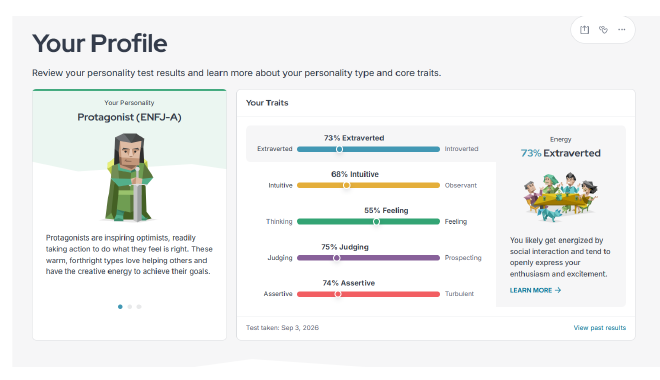
16Personalities
Protagonist
ENFJ-A
Background
Dutch+ Croatian
People · Ideas
Action · Impact
Table of contents
The whole portfolio, one click away
Part 01 · Personal Handbook
- 1Personality Test
- 2Hofstede - Cultural Background
- 3Double-Loop Success - Dragon's Den Scenario
- 4Disciplinary Radar Chart
- 5Rules of Life
- 6Integrity & Authenticity Reflection
- 7What Do You Bring to the Table?
- 8Ideal Collaboration Environment
- 9Team SWOT + Reflection
- 10Group Value Video
- 11Circle of Influence
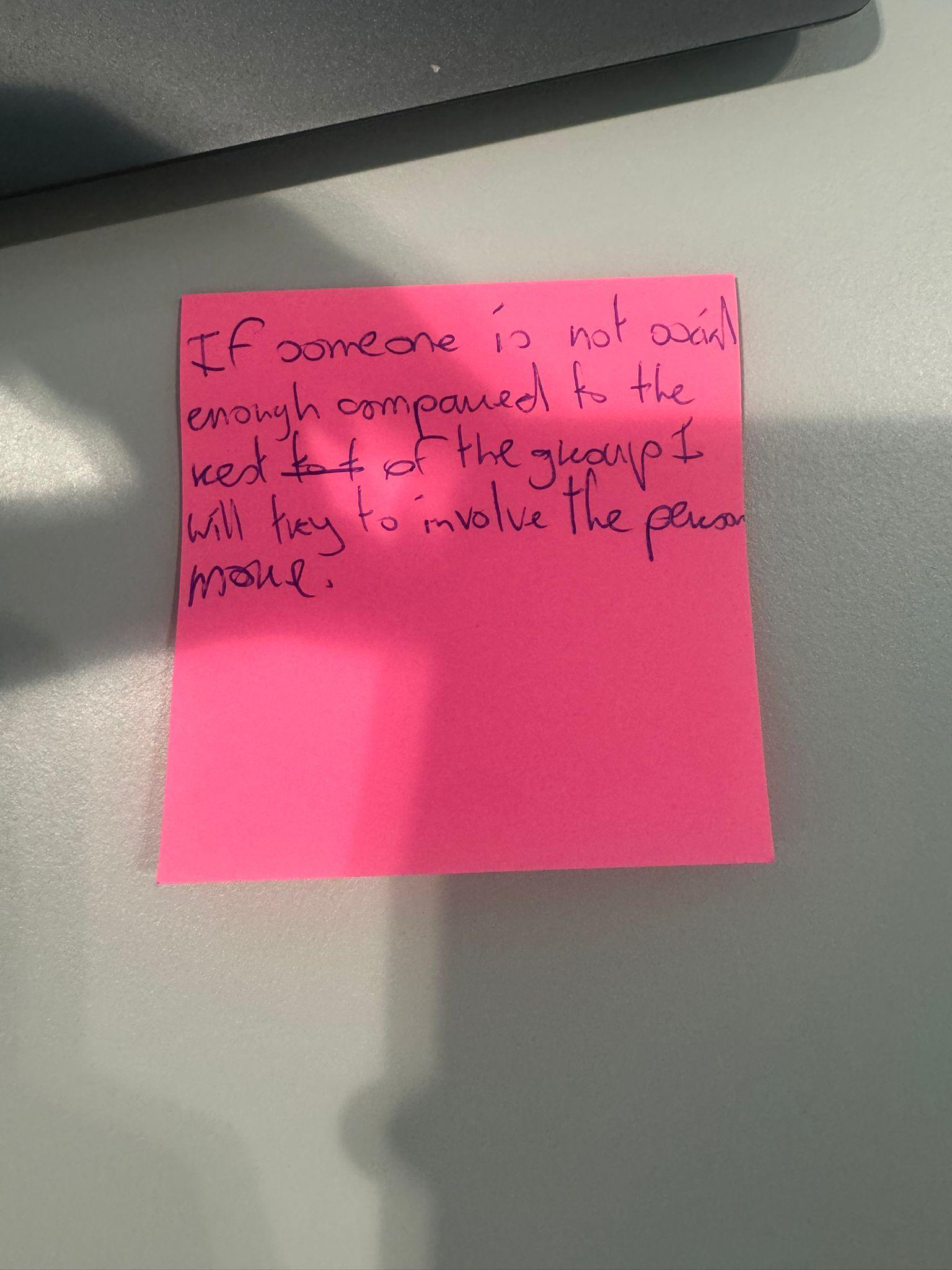
- 12If/Then Protocol
- 13Reflection on the IDG Being
- 14Overarching Conclusion
Part 01
Personal Handbook: how to work with Jip
Understanding how I work in interdisciplinary teams.
1 · Personality test · 1.1 Reflection
Protagonist (ENFJ-A)
I recognise especially the extraverted side of this result in the way I work. I am social, I take initiative quite fast and I find it easy to connect with different people. For me the test is mainly a way to recognise patterns in myself, but I still base the reflection below on how I actually work and on feedback I get from other people.
When I look at myself, I think I am mainly social, ambitious and quite action-oriented. In a group I normally take initiative pretty fast, but I do not need to be the only person leading. I actually prefer it when leadership is divided and people use the qualities they are best at.
I like working with other people, but I also want some freedom in how I do things. I am quite direct and to the point, and most of the time that helps me to keep things moving. At the same time I know this can also be a weakness, because not everyone communicates in the same way.
Something I notice about myself is that I can take on too much at the same time. This happens especially when school, work and deadlines come together. Under pressure I also become more focused on getting things done, which can make me more direct towards other people.
What I want to get better at is keeping the directness that also fits me, while listening a bit more before I give my opinion. For me that is a better balance than trying to completely change the way I am.
16Personalities result · Appendix C
1.2 · Top 3 core values
Ambition, Independence, Responsibility
Ambition
Ambition is important to me because I always want to keep improving myself. I like having goals to work towards and when I reach something, I normally already start thinking about what can be the next step. This is something I have in business, but also in my personal life.
Independence
For me independence is mostly about making my own choices. I like working together with other people, but I also notice that I want to have the space to do things in my own way. With my own business I have this a lot, because I can decide myself what I think is the best way to do something. If it works out good that is nice, but if it doesn't, it was also my own choice.
Responsibility
For me responsibility is more about that people can trust me with the things I say. If I tell a customer or someone I work with that I will do something, I also want to make sure it actually happens. Sometimes when it gets really busy this can be more difficult, but I don't like saying I will do something and then not keeping that agreement.
Most difficult under deadline pressure
I think responsibility is the most difficult value for me when there is a lot of deadline pressure. This is mainly because I sometimes take on too many things at the same time. Normally this goes fine, but when different deadlines come together I notice that I can lose some overview and this gives me more stress.
What I learned from this is that I need to plan more ahead and sometimes also say no to something, even when I think it could be interesting. I notice that when I do this I have more overview and can also focus better on the things that are actually important.
2 · Hofstede · cultural background
Half Dutch, half Croatian
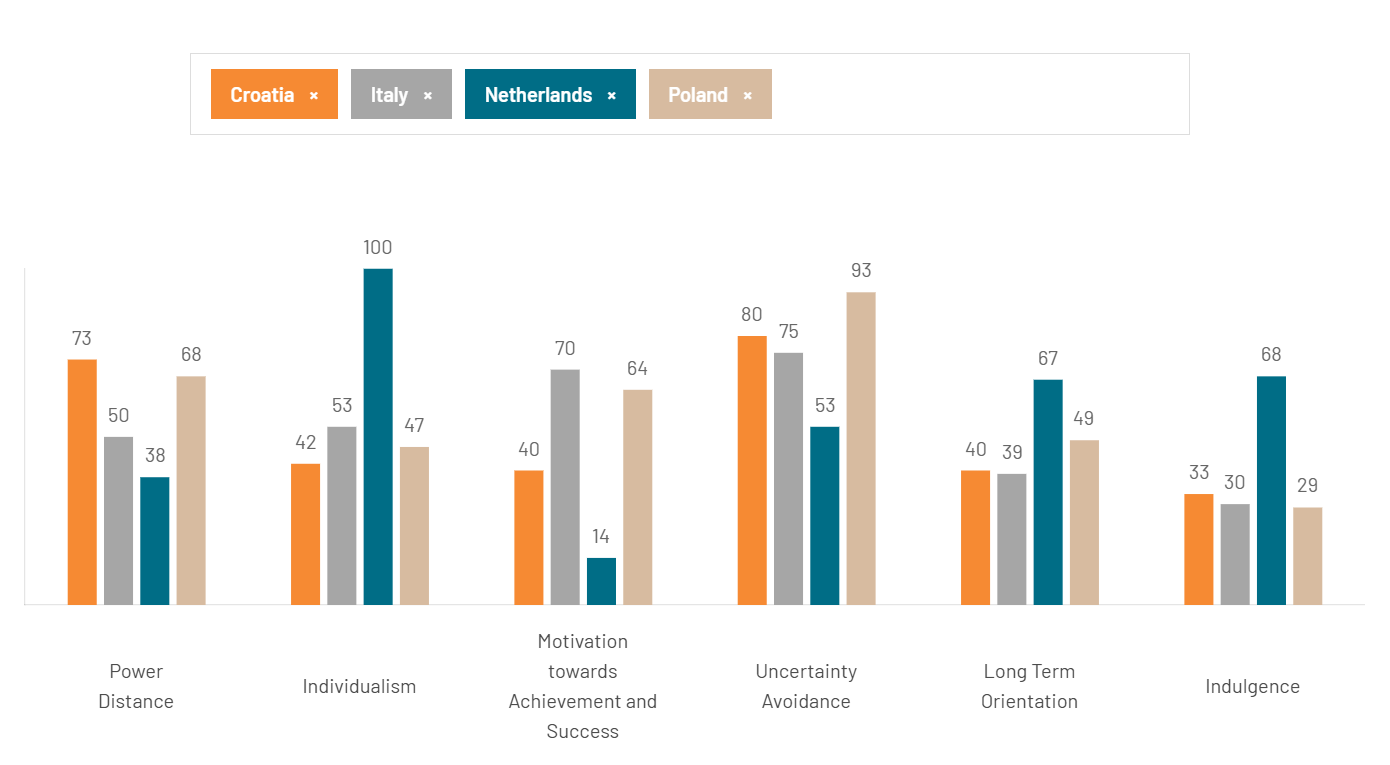
When I look at the Hofstede 6D comparison used in class (Avans Hogeschool, 2026a), I notice that there are some clear differences in our group. The Netherlands scores higher on individualism, while Croatia and Poland score higher on power distance and uncertainty avoidance.
For me this is interesting because I am half Dutch and half Croatian. I recognise both sides in myself. I like the Dutch directness and freedom, but I also think clear agreements and responsibility are important.
What I mainly take from this is that I should not expect everyone to communicate or work in the same way as I do. I can still be direct, but I also need to stay flexible enough to understand where someone else is coming from.
Power Distance
Individualism
Motivation towards Achievement and Success
Uncertainty Avoidance
Long Term Orientation
Indulgence
Hofstede 6D comparison used in class (Avans Hogeschool, 2026a). Original chart under Evidence.
3 · Double-loop success
Dragon's Den scenario
Pitch in front of almost the whole first and second year of the study. This reflection uses the Double-Loop Learning framework discussed in the Being workshop (Avans Hogeschool, 2026b).
Single Loop
Change your action
Practice the pitch more before doing it, so I know better what I want to say and feel less nervous.
Double Loop
Question the assumption behind your action
I thought that when I was nervous, I was probably not ready enough to give a good pitch.
1. The Situation
During Dragon's Den I had to pitch alone in front of almost the whole first and second year of my study. I was really nervous before I had to start, because I never really pitched alone for such a big group before.
2. Your First Reaction
I started thinking a lot about what could go wrong. For example that I would forget my story or that I would stand there and not know what to say anymore.
3. Why?
I think I was mainly nervous because I thought I needed to feel confident before I could give a good pitch. Because I did not feel confident at that moment, I started doubting myself more.
4. Challenge It
After doing the pitch I noticed that this was actually not really true. I was still nervous when I started, but after a while it became less. When I was actually doing the pitch I got more comfortable and it went better than I expected.
5. Double-Loop Moment
What I learned from this is that I do not first have to feel confident before doing something. Sometimes I just have to do it first and the confidence comes because I am doing it more often.
6. New Response
If I have to do something like this again, I would still be nervous, but I would not make it bigger than it is. I would prepare myself good and then just do it. I know now that the nerves will probably become less when I start.
7. Team Impact
I think this can also help me when working in a team. Sometimes you have to do things you are not fully comfortable with. I learned that I should not wait until I feel completely confident, but sometimes just take the responsibility and learn from doing it.
4 · Disciplinary radar chart
Three views on my IDG profile
Compare the three assessments
Toggle a view to see how my profile shifts
4.1
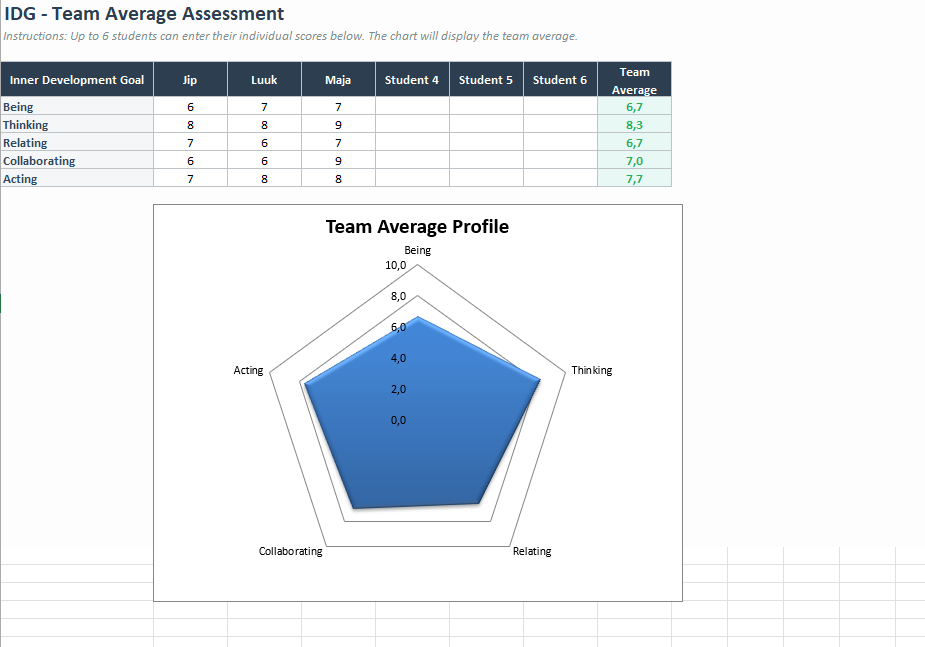
Team Average Assessment
Jip, Luuk & Maja
| IDG | Jip | Luuk | Maja | Avg |
|---|---|---|---|---|
| Being | 6 | 7 | 7 | 6,7 |
| Thinking | 8 | 8 | 9 | 8,3 |
| Relating | 7 | 6 | 7 | 6,7 |
| Collaborating | 6 | 6 | 9 | 7,0 |
| Acting | 7 | 8 | 8 | 7,7 |
When I look at our team radar chart, Thinking is the strongest score. Acting and Collaborating are also quite high. I recognise that in our group because we normally want to understand the problem, but we also do not want to keep talking forever before something happens.
Being and Relating are a bit lower. I recognise that in myself as well. I can be quite focused on the result and sometimes I am already thinking about the next step while another person is still explaining their view. For me the learning point is not to become less decisive, but to listen a bit longer before I decide what I think.
4.2
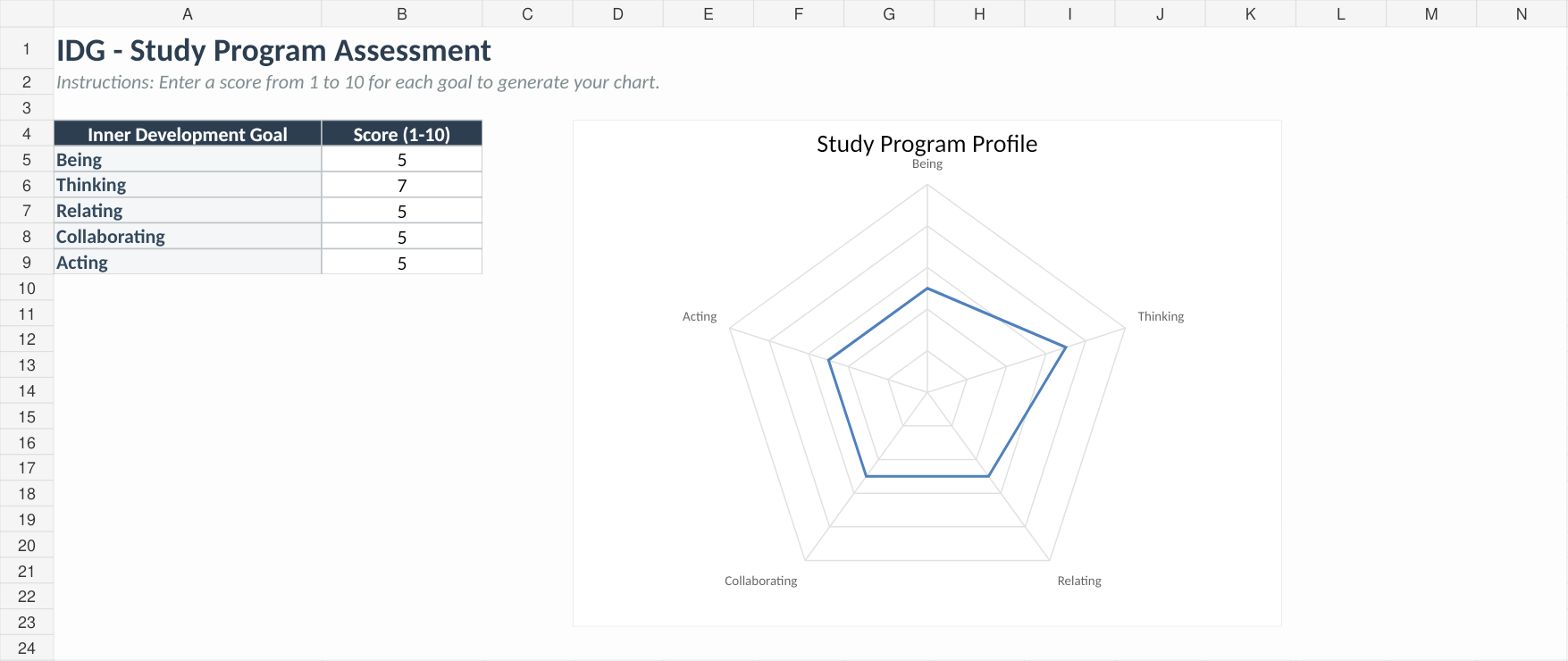
Study Program Assessment
Being 5, Thinking 7, Relating 5, Collaborating 5, Acting 5
I gave Thinking a 7 because I think ORM puts you in situations quite often where you have to think critically about a problem instead of only learning theory. Over the last two years I also notice that I developed in the way I look at problems and make decisions.
My ORM bias
I can move quite fast towards a practical solution. That helps me with action, but it can also mean that I already want to solve something while someone else is still analysing the problem.
In interdisciplinary teamwork I need to be aware of this and leave more space for other ways of thinking.
4.3
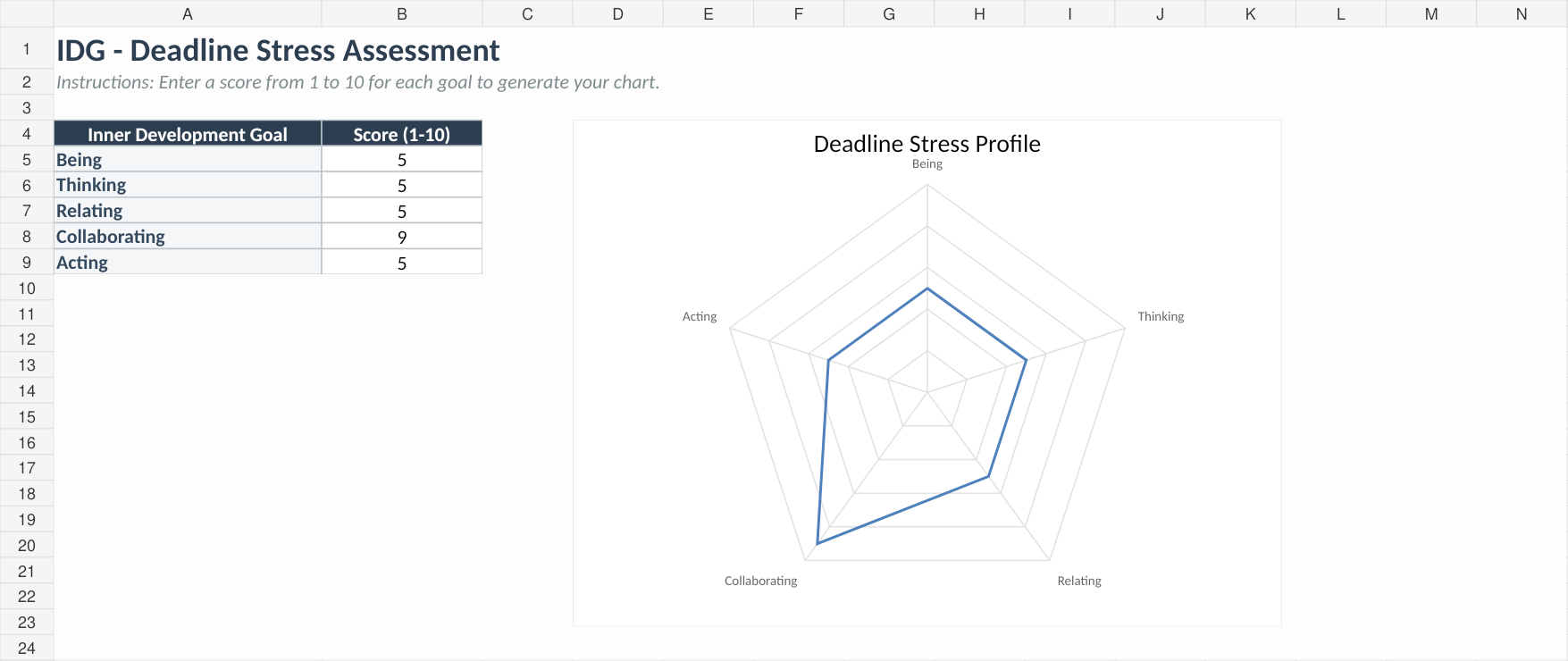
Deadline Stress Assessment
Being 5, Thinking 5, Relating 5, Collaborating 9, Acting 5
Under deadline pressure I gave Collaborating a 9 because that is when I become very focused on the group getting to the finish. If the deadline is tomorrow and we are behind, I normally start dividing tasks, checking whether people are still doing what they need to do and making sure everybody has something useful to work on. I also pick up extra work myself if that is needed. I do notice that I can become more direct in those moments.
5 · Rules of life
How my values turn into behaviour
Ambition
When I see a new opportunity, I first want to look if I really have time for it. I know from myself that I sometimes want to do too much at the same time. Because of this I want to think first before I directly say yes to something new.
Independence
I like to do things in my own way, but when I work in a team I also need to listen to the other people. I do not want to make important decisions too fast by myself. First I want to hear what the others think and after that decide together what is the best way.
Responsibility
When I say that I will do something, I also want to make sure that I really do it. If I see that I cannot make a deadline or agreement, I want to say this as early as possible. This is better than waiting until the last moment and giving stress to myself and the team.
Top 3 rules for the team work
- 1
Always communicate about your input and situation.
(communication)
- 2
Bring good vibes to the team.
(positivity)
- 3
Always do your best in team and individual work.
(ambition)
5.1 · 150-word Rule of Life Analysis · Responsibility (read)
In the coming two weeks I think school and work can become busy at the same time. This happened before and I know from myself that I sometimes say yes to too many things because I think I can do everything. Normally this goes fine, but when different deadlines come together I can lose some overview and this gives me stress.
My Rule of Life for responsibility is that when I say I will do something, I also want to make sure that I really do it. Because of this I want to look better at my planning before I make new agreements. If I see that I cannot finish something in time, I want to say this earlier and not wait until the last moment.
For me this is important because responsibility is also about being honest about what I can do. This gives me more overview and also makes it easier for the people I work with.
6 · Integrity & authenticity
"For me my father is still the clearest example of someone who is authentic."
He worked hard to get where he is, but money or status never really changed the way he acts. He is basically still the same person, and that is something I respect a lot.
In group projects I also think authenticity means that I should say what I really think. I am naturally quite direct, so I usually do that anyway. The challenge for me is more in how I bring that opinion, because being honest does not mean I always have to be the hardest or fastest person in the conversation.
I still prefer that problems are discussed directly instead of being ignored. At the same time I learned that the way I start that conversation matters. Asking first what is going on can sometimes work better than immediately reacting from irritation.
7 · What do I bring to the table?
Initiative and the social side of a group.
First, I normally take initiative and help to keep the work moving. I take a bit of a leading role, but not in a way where I want to decide everything myself. In our current group I think that role is divided quite well.
Second, I think I am quite good at the social side of a group. I can normally have a good conversation with almost everyone and I often get back that people find me easy and fun to work with. I can also bring some humour into the group and connect people with each other. I think that helps the chemistry of the group and, in the end, also the output.
Vulnerability
My directness can also create irritation. I know from feedback that I can sometimes be too to the point.
What I want
I do not want to lose that directness, but I do want to become better at first hearing someone out and then giving my opinion.
8 · Ideal collaboration environment
Where I work best
Clear agreements
I work best in a team when it is clear who is responsible for what and when something needs to be finished. This gives me more overview and makes it easier for me to focus on my own tasks.
Direct communication
For me it is important that people say it when something is not going well. I prefer that we talk about problems directly with each other instead of waiting too long or talking about it with other people first.
Freedom with responsibility
I like to have some freedom in how I do my tasks. At the same time I think everybody in the team should take responsibility for the agreements that are made. When everyone does this, I think the collaboration works better and there is also more trust in the team.
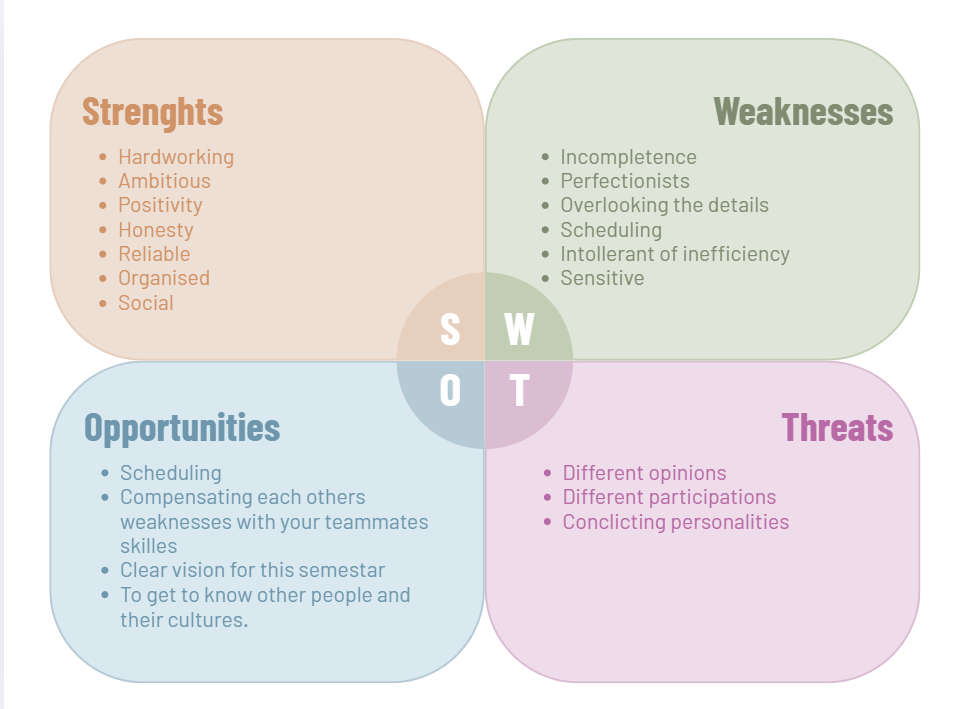
9 · Team SWOT
Our team in four quadrants
Strengths
S- Hardworking
- Ambitious
- Positivity
- Honesty
- Reliable
- Organised
- Social
Weaknesses
W- Incompleteness
- Perfectionists
- Overlooking the details
- Scheduling
- Intolerant of inefficiency
- Sensitive
Opportunities
O- Scheduling
- Compensating each others weaknesses with your teammates skills
- Clear vision for this semester
- To get to know other people and their cultures.
Threats
T- Different opinions
- Different participations
- Conflicting personalities
From the Team SWOT, Ambitious is the strength I recognise the most in myself. I like moving forward and I am usually not the person who waits very long before taking action. I also think the social side is one of my strengths, because I can normally connect quite easily with different people in the group.
The weakness I recognise most is Intolerant of inefficiency. If I feel that someone is doing too little or something is taking much longer than needed, I can get irritated and become more direct. That is useful up to a point, but it can also make the atmosphere worse if I react too quickly.
Who complements me · Maja
She is also critical and really stays on top of things, but I especially learned from how she plans and makes sure things are arranged on time. That is useful for me because I can be more focused on moving and solving things in the moment. In that way the differences in the group can actually make the team stronger.
10 · Evidence · video
Group Value Video
In the video we mainly show how important communication and responsibility are in a group. When someone is not there or does not finish their part, this can quickly create irritation. For me the main point is that it is better to say this directly to each other instead of talking around it. At the same time, everyone is responsible for doing their own part and communicating when something is not going well. I think this fits quite well with how I like to work in a team: clear communication, responsibility and being honest with each other.
Watch on MyMedia11 · Circle of influence
Control, influence, concern
CONTROL
My own reaction, communication and agreements
INFLUENCE
CONCERN
Control
My own reaction, the way I communicate and the way I make agreements with the group.
Influence
Keeping someone involved, asking what is going on and making clear what still needs to be done.
Concern
How much effort another person finally decides to put into the project and whether that person is actually present.
At the start of this module there was one group member who was absent more often than he was there. He did some things online, but for me it was still irritating because I think being physically present in the lessons is also part of working together. I noticed that I was watching his contribution more closely than the contribution of the others.
Looking back, I do not think reacting from irritation was the best way. A better first reaction would have been to ask why he was not there as much and whether there was something we could help with. I can still keep someone sharp and make clear agreements, but I do not have to start the conversation already irritated.
For me that is the main point of the Circle of Influence used in class (Avans Hogeschool, 2026a). I can influence the conversation, the agreements and the way I react. I cannot decide how much effort another person will finally put in. If something is really outside my control, I can worry about it, but that does not actually change anything.
12 · If / then protocol
Operating manual for my team
This protocol is based on situations I already recognise from my own behaviour during teamwork. The goal is to make it clear for my team what they can do when I start showing behaviour that can negatively influence the collaboration.
Taking on too much
- Warning sign
- I start picking up more work myself and checking more closely what everybody else is doing.
- Trigger
- This normally happens when a deadline is getting close and I feel that the group still has too much work left. My first reaction is to make sure we get to the finish, even if that means I take on extra work myself.
IF I start taking over too much work because the deadline is close,
THEN remind me to first divide the tasks clearly and check what I really need to do myself.
Moving too quickly towards a solution
- Warning sign
- I become very direct and to the point, especially when I think something is inefficient or taking too long.
- Trigger
- I naturally like to move forward and I know from feedback that my directness can sometimes be a bit much for other people. This happens more quickly when I am already irritated or when I feel that the group is losing time.
IF I become too direct or start pushing my own view too fast,
THEN tell me directly and ask me to first hear the other person out before I react.
Overthinking when I am nervous
- Warning sign
- I start thinking too much about what can go wrong.
- Trigger
- I noticed this during my Dragon's Den pitch. When I had to do something I was not fully comfortable with, I started thinking about what could go wrong.
IF I start overthinking what can go wrong,
THEN remind me to focus on what I can control, prepare myself and just start.
13 · Reflection on the IDG Being
Some qualities are a strength and a weakness at the same time
Strength
Direct, ambitious, social, initiative
Risk
Too controlling or too direct under pressure
Development
Listen before reacting
Proof of future growth
People who currently describe me as very direct also start saying I listen well.
Looking back at the Being assignments and the IDG framework (Inner Development Goals, n.d.; Avans Hogeschool, 2026b), I mainly learned that some qualities can be a strength and a weakness at the same time. I am social, ambitious, direct and I normally take initiative fast. That helps a group move forward, but under pressure I can become more controlling or too direct. I recognise that especially when deadlines are close or when I think someone is not contributing enough.
The biggest learning point is not that I need to become less direct. I want to keep that, because it is part of how I work. What I want to improve is the moment before I react. I want to let people finish, listen to what they mean and then give my opinion. The Hofstede assignment made me more aware that people can communicate and work differently from me.
The Dragon's Den example showed me that I do not have to feel completely confident before I start something. I became less nervous by doing it. If I connect all these assignments, Being for me is mainly about knowing my own patterns better. If people who now call me direct also start telling me that I listen well, then I know I improved.
14 · Overarching conclusion
The pattern in my handbook
Keep
- Directness
- Initiative
- Social energy
Watch
- Irritation
- Moving too fast
- Taking on too much
Develop
- Listening longer
- Understanding perspectives first
- Staying flexible
When I look at my Personal Handbook as a whole, I see a pretty clear pattern. I am social, ambitious, direct and I like to take initiative. I often take a bit of a leading role, but I do not need to be the only leader. I think I work best when everybody uses their own strengths and there is still enough freedom in how people do their work.
My biggest strength in a group is probably the combination of initiative and the social side. I can normally level quite easily with different people, make the atmosphere a bit lighter and keep people connected. My biggest risk is that my directness becomes too hard when I am irritated or when I think things are inefficient.
The main thing I want to develop is therefore listening without losing my directness. I want to give other people more room to talk before I form my opinion or give feedback. I also want people in a team to be direct with me when I am going too fast or coming across too hard.
For me, progress is not only something I can decide for myself. If people who currently describe me as very direct later also tell me that I am a good listener, that would be real proof for me that I developed.
Part 02
Impact on Team Dynamics
How my communication, thinking, emotions and drive affect the team.
This reflection is based on how I experienced the current project group and the Thinking and Relating workshops (Avans Hogeschool, 2026c). The three things I focus on are Thinking, Communication and Perspectives, and Emotions and Collaboration.
15.1
Thinking
Debate · Privacy vs Security
The debate was a good example for me because our topic was privacy versus security around personal data and I had to defend the security side. What I liked about this exercise is that you are forced to think from a certain perspective instead of only arguing from what you would normally say yourself. It showed me quite clearly that the way you look at a problem can change depending on the position you have to defend.
Prototype
A bidding platform for vacant commercial locations
Potential users can bid what they would be willing to pay per month, while a filtering system also checks whether the business fits the location and the existing businesses around it.
At the beginning we were definitely not all on the same line. Instead of immediately going with one idea, we looked critically at the different options and eventually combined the strongest parts. For me this was a good example that different perspectives can actually make the final idea better.
Link to IDG Thinking: This connects directly to IDG Thinking and the perspective skills from the workshop (Avans Hogeschool, 2026c), because I had to step outside my own way of thinking and seriously look at another perspective before making a decision.
15.2
Communication and Perspectives
My style
Direct, to the point, initiative
Positive impact
Clarity, movement, social connection, humour, group chemistry
Risk
Not everyone communicates the same way
Development
Give someone space to explain first
My communication style is quite direct and to the point. I also take initiative quickly and I am not afraid to say what I think. That helps when a group needs clarity or when something just has to move forward. At the same time, I know from feedback that I can sometimes be too direct and that not everybody is used to that.
The positive feedback I get is that people generally find me easy and fun to work with. I am social, I can normally level with different people and I like keeping the atmosphere in a group good. I can make people laugh and connect people with each other. I think that social side is important because a group does not only need people who do tasks, but also some chemistry between the people doing them.
My learning point is that direct communication works better when I first give someone the space to explain their view. I do not want to become less direct, but I do want to become more flexible in the moment before I react. For me this connects to Communication and Perspectives and also to active listening from the Relating workshop (Avans Hogeschool, 2026c). My direct style can create clarity, but I also need to leave enough room to actually understand the perspective of someone else.
15.3
Emotions and Collaboration
A clear example happened at the start of the module. One group member was absent more often than he was present. He did some things online, but I still became irritated because for me being present in the lessons is also part of working together.
What happened
I noticed that I started watching his contribution more closely and became more critical towards him.
Looking back
Looking back, I think I could have handled that better. Instead of starting from irritation, I could first have asked why he was absent and whether there was something we could help with.
For me this connects to empathy from the Relating workshop (Avans Hogeschool, 2026c): first trying to understand what is behind someone's behaviour before reacting. I can still be clear about what I expect, but the starting point of the conversation matters.
Under deadline pressure I…
When there is real deadline pressure, I normally become more focused on coordinating the group. I divide tasks, check whether people are still doing what they need to do and I also take on extra work myself if needed. That can help the group reach the deadline, but it is also exactly the situation where I need to watch my directness.
For me the main lesson is that my drive can help a team, but only if I combine it with listening and staying calm enough to keep the collaboration good. This connects to Emotions and Collaboration, because irritation and deadline stress clearly change the way I communicate and can influence the atmosphere in the group.
My drive can help a team, but only if I combine it with listening and staying calm enough to keep the collaboration good.
Part 03
Interdisciplinary Contribution & Future Growth
What I bring from ORM and how I want to grow further.
This part is mainly about the last two IDG dimensions: Collaborating and Acting (Inner Development Goals, n.d.; Avans Hogeschool, 2026d). I use things that actually happened in the group, the workshops and feedback to show what I contributed and what I still want to improve.
16.1
IDG 4 – Collaborating
Communication, co-creation, trust and mobilising people
In the Collaborating workshop, the focus was on communication, co-creation, an inclusive and intercultural mindset, trust and mobilising people (Avans Hogeschool, 2026d). I recognise especially communication and mobilising in my own way of working. I connect quite easily with different people, I like clear agreements and direct communication, and I often take initiative when the group needs to move forward. I take a partly leading role, but I do not need to be the only person leading.
Communication
Direct, clear, and easy to connect with.
Co-creation
Different perspectives helped improve the prototype.
Trust
Clear agreements and responsibility matter to me.
Mobilising
Under pressure I help move the group forward.
Inclusive / intercultural mindset
I learned that people from different disciplines and backgrounds can think and communicate differently, so I need to stay open and flexible.
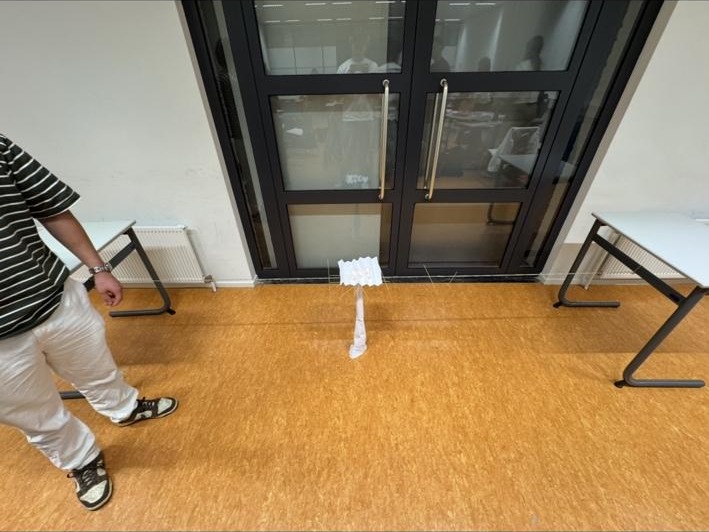
A practical workshop example was the Marshmallow Challenge. We had to work together under time pressure towards one shared result. For me this was a clear example that collaborating is not only about talking, but also about adjusting, dividing attention and working together towards something concrete.
I also learned from Maja during the project. She was strong in planning, structuring and keeping things on track. I am sometimes more focused on moving forward quickly, so her way of working showed me that speed is useful, but structure is just as important. The prototype process showed something similar: we did not all start with the same idea, but by discussing different perspectives we came to a stronger concept.
16.2
IDG 5 – Acting
Turning ideas into something concrete
Courage
Dragon's Den showed that I can act even when I feel nervous.
Creativity
The prototype became a bidding platform for vacant commercial locations.
Perseverance
Under deadline pressure I keep going and help the group finish.
Responsibility
I take initiative and pick up extra work when needed.
Optimism
I bring positive energy and keep the group solution-oriented.
Risk: my drive can also make me too direct or impatient.
For me, Acting is mainly about actually doing something with an idea instead of only talking about it, which fits me quite well (Avans Hogeschool, 2026d). I take initiative quickly and I am willing to take responsibility when needed. I recognise courage in my Dragon's Den experience, because I learned that I can still act while I am nervous. I recognise creativity in the prototype process, where different ideas were combined into the bidding platform for vacant commercial locations. Perseverance and responsibility show most clearly under deadline pressure, when I start dividing tasks, checking progress and sometimes take on extra work myself.
The risk is that this drive can also make me too direct or impatient. For me, Acting is therefore not only about moving fast, but about taking action without losing the people around me.
16.3
My Interdisciplinary Contribution
How I add value in collaborative projects
Knowledge
Entrepreneurial and practical ORM perspective.
Skills
Initiative, direct communication, connecting people, moving from discussion to action.
Attitude
Responsible, action-oriented, social, and committed.
Added value
I help turn ideas into concrete solutions and keep people moving towards a result.
I think my contribution mainly comes from the combination of how I work and what I bring from ORM. I take initiative, I am direct, I bring energy into the group and I normally look quite practical at an idea.
During the prototype process I was especially focused on whether the idea could actually work. With the bidding platform, potential users could show what they were willing to pay per month for a vacant commercial location, while the filtering system checked whether a business fitted the location and the existing businesses around it.
For me my added value was mainly that I did not only want to discuss ideas, but also wanted to turn them into something that could actually work for the user and the location. At the same time, working with people who think and work differently showed me that my own way is not automatically the best way.
16.4
Proof Collected & Future Development
Evidence from projects and feedback · How I will keep growing
The examples I use as proof are the Marshmallow Challenge, the Privacy vs. Security debate, the prototype development, peer feedback, the radar charts and real deadline situations in the group.
- Marshmallow ChallengeProof of collaboration01
- Privacy vs. Security debateIDG Thinking02
- Prototype developmentBidding platform03
- Peer feedbackDirect, social and easy to work with04
- Radar chartsThree assessments05
- Real deadline situationsDeadline-pressure examples06
Keep
Directness, initiative, and social energy.
Improve
Listen longer before reacting.
Approach
First let someone finish, then understand their perspective, and only then give my opinion.
Future application
Adapt my communication to different disciplines and cultural backgrounds.
Proof of growth
When people who now describe me as very direct also start telling me that I am a good listener.
The qualities I want to keep are my directness, initiative and social side. My main development point is listening longer before I react. My approach is simple: first let someone finish, understand their perspective and then give my opinion. I also want to stay more flexible when someone approaches a problem differently from me.
For me the best proof that I improved would be when people who now describe me as very direct also start saying that I listen well. I want to take that with me when I work with people from other studies and cultural backgrounds in the future.
16.5 Final Format · Appendix B
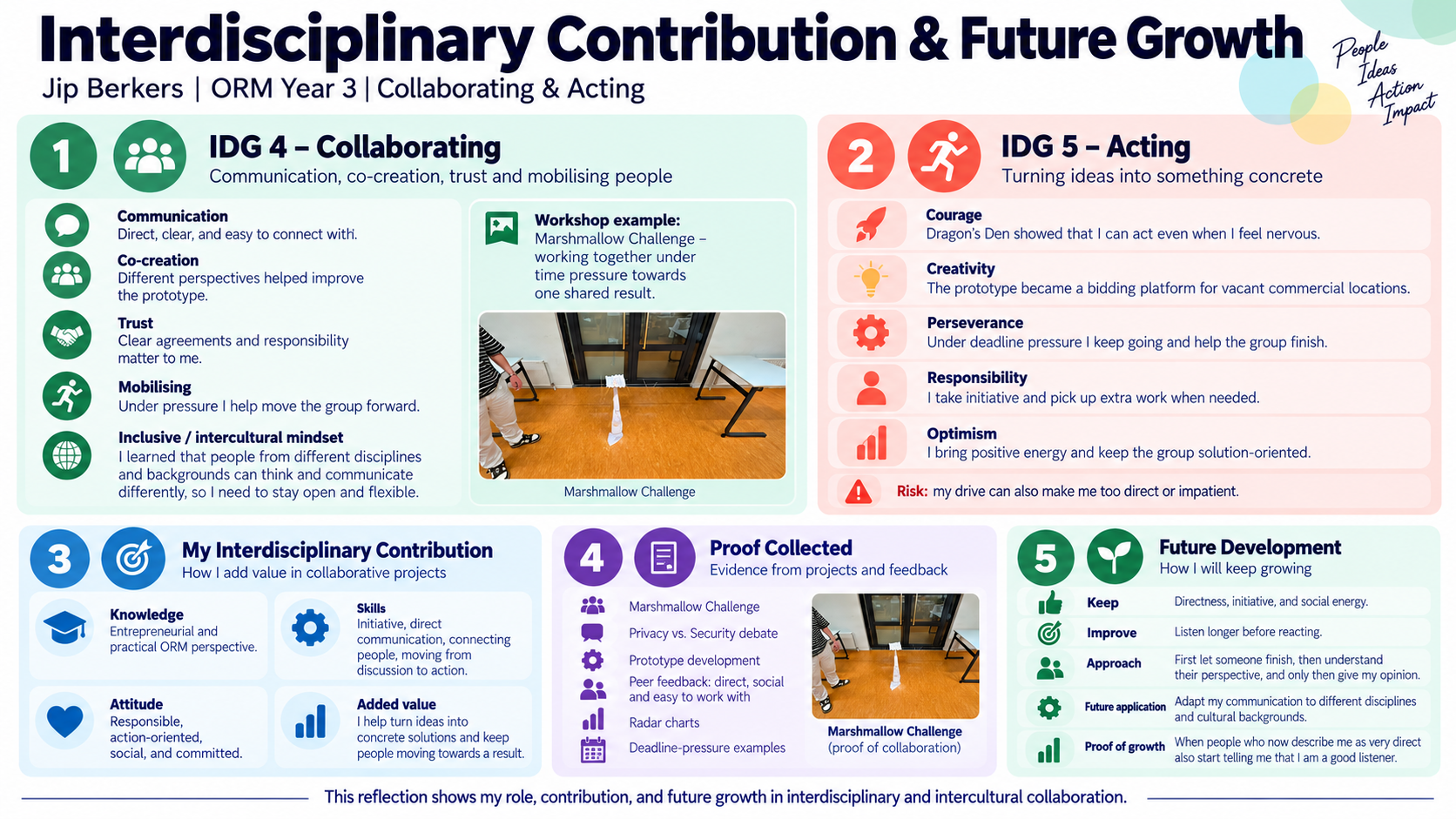
Final infographic
Voice-over
Voice-over / MyMedia link · opens in a new tab
Appendix A
Map Your Double Loop
What I normally do
When I get nervous I start thinking too much about what can go wrong.
Because I believe / assume
I thought that I first needed to feel confident before I could do a good pitch.
But what if that assumption is wrong?
I can still do a good pitch when I am nervous. The confidence can also come when I am already doing it.
Then I could instead...
Accept that I am nervous, prepare myself and just do it.
Connect It to Your Portfolio
I realised that when I have to speak in front of a big group, I can get nervous quite fast and start thinking about what can go wrong. This happened during Dragon's Den, where I had to pitch alone in front of almost the whole first and second year of my study. Before the pitch I was really nervous, but when I started I noticed that it became less. I also noticed that the more I did pitching, the better I became at it.
Before this I thought that I first needed to feel confident before I could give a good pitch, but now I know that this does not always work like that. Sometimes I just have to do it and the confidence comes after. I think this can also help me in teamwork because I will be more likely to do something even when I am not completely comfortable with it yet.
Evidence
Original portfolio evidence
Includes Appendix C · Personality Test Result (16Personalities)
Click any item to open it full size.
References
- 16Personalities. (n.d.). 16Personalities. https://www.16personalities.com/
- Avans Hogeschool. (2026a). Class 1.2 slides general [PowerPoint slides]. Professional Development Line, Create Impact Together.
- Avans Hogeschool. (2026b). Week 1.1 intro and Being [PowerPoint slides]. Professional Development Line, Create Impact Together.
- Avans Hogeschool. (2026c). W3-4, IDG2-3 Thinking & Relating [PowerPoint slides]. Professional Development Line, Create Impact Together.
- Avans Hogeschool. (2026d). W5-6, IDG4-5 Collaborating & Acting [PowerPoint slides]. Professional Development Line, Create Impact Together.
- Inner Development Goals. (n.d.). Inner Development Goals. https://www.innerdevelopmentgoals.org/
Jip Berkers · Personal Portfolio · Create Impact Together · ORM Year 3 · Avans Hogeschool · 2026